

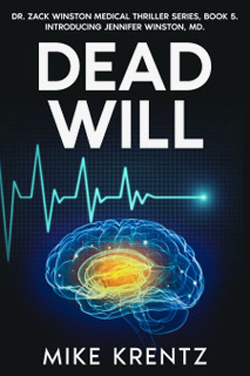
Dr. Zack Winston #5
February 17, 2026
Purple Papaya LLC
Available in: Audio, e-Book, Trade Size
BUY NOW

eBook

Audio


Dead Will
When patients across the Washington DC area arrive in emergency rooms with profound apathy, impaired judgment, and erased ambition, seasoned emergency physician Dr. Zack Winston senses something more sinister than a medical mystery. The victims are not intoxicated, not psychotic, and not suffering a stroke—yet each seems stripped of the free will that once defined them.
The common thread emerges when Zack’s daughter, Dr. Jennifer Winston, a first-year neurosurgery resident, recognizes a chilling pattern: every patient has undergone deep brain stimulation (DBS) under the direction of celebrated functional neurosurgeon Dr. Lucian Hale. Marketed as revolutionary, Hale’s procedures promise relief from neurological disease—but may quietly rewrite the human mind.
As Jennifer digs deeper into Hale’s work, she confronts alarming ethical breaches inside an elite neurosurgical culture that prizes prestige over patients. What begins as an unsettling complication soon suggests deliberate manipulation of the brain’s executive centers—technology capable of suppressing dissent, ambition, and free will itself.
Meanwhile, across the Potomac, U.S. Attorney Bridget Larsen faces her own crisis when a key whistleblower in a federal corruption case suddenly suffers blunted cognition and decompensates before a grand jury. Her case threatens to collapse—unless Bridget can prove that powerful corporate and medical interests are engineering neurological compliance to protect a clandestine network of profiteers.
Zack, Jennifer, and Bridget race to put the pieces together. They discover a plot that connects experimental brain surgery, unethical companies, and government manipulation. The deeper they push, the more dangerous the opposition becomes—and the more personal the cost. With lives, careers, and constitutional freedoms at stake, the trio must expose the truth before the technology spreads beyond the hospital and into the machinery of power itself.
But will one of them become the ultimate victim instead?
DEAD WILL is a high-stakes medical thriller that explores the dark edge of neuroscience, the fragility of autonomy, and the terrifying question at the heart of modern medicine: What happens when the cure steals the very essence that makes us human?
Dr. Lucian Hale, Chief of the Functional Neurosurgery Service at District of Columbia University Medical Center (DCUMC), a world-renowned pioneer in the stereotactic treatment of a variety of neurological disorders, prepared to perform a revolutionary procedure. If successful, Hale would ascend to the summit of the functional neurosurgery community, small as it may be.
Ethics? Bah!
To avoid inevitable controversy, Hale would not perform the operation at DCUMC, but at his own freestanding, private, and secure facility miles away in another state. Few people knew of its existence.
Hale looked up as his team brought the patient into the prep room.
The young woman looked frailer than Hale recalled. Perhaps losing control had created that effect. Hale had seen the same effect on other overproud women. This one certainly deserved a heavy dose of humility, given all the trouble she’d caused him and his associates.
Hale approached his patient. She sat in a wheelchair, her arms and legs restrained with gauze. Even through the sedation, she glared at Hale with hostile blue eyes while she fought the restraints. The gauze held, but that did not keep her from trying again. And again.
He spoke to his assistant. “Give her Etomidate. Minimal dose. That might settle her down a bit.”
The assistant, a young, buff physician in tight surgical scrubs, looked like he’d stepped out of a medical romance TV show. “Would you consider fentanyl instead, Dr. Hale?”
“No. She needs the full sensory experience.”
The patient struggled harder.
Hale leaned over and spoke in her ear in a gentle voice. “This is one of my favorite parts. Delete a foundation of female vanity.”
Someone handed him a pair of scissors, which he used to cut off the woman’s long blond hair. Then, he picked up an electric razor and shaved her entire scalp using multiple strokes and pressures. The woman grimaced against the razor’s sting.
Hale smiled. “I’ll bet that feels better already.”
The woman’s eyes narrowed, and she spoke in a frail but firm voice. “Go to hell.”
Hale touched her shoulder. “Now, now. We are about to change your life for the better. Maybe salvage your career. You will thank us when it’s all done.”
He turned away without waiting for a response and spoke to his assistant. “Stay close to her.”
“Of course. I understand the desired endpoint.”
Hale turned to a medical technician. “Let’s get her into the helmet.”
The tech handed him an apparatus made up of a circular metal band with protruding pencil-like pins. Four metal legs extended downward from the metal band to the level of the woman’s shoulders.
Hale placed the apparatus around the patient’s head with the band around her forehead. He fussed a bit to get it into the precise position. Just when he thought he had it right, the patient rotated her head.
“Hold still.”
She rotated her head to the other side.
Hale spoke to another doctor in the room. “Hold her head.”
The man complied by threading two hands under the frame and clamping them against either side of the woman’s jaw.
The assistant spoke up. “Lidocaine, Doctor?”
“No. I told you she needs to feel the sensations.”
The assistant sighed, non-plussed.
Hale glared at him, then screwed the first pin into the patient’s unanesthetized scalp.
The woman screamed.
Hale whispered in her ear. “So much for going to hell.”
BUY NOW
eBook
Audio
Dr. Zack Winston is back. His wife and daughter join him in the line of fire. Dead Will is book five in the series and features Zack taking a short-term contract to work at the emergency department where his daughter Jennifer is a first year neurosurgery resident. They notice a pattern of patients with strange neurological behaviors and investigate, leading to a much larger conspiracy. Krentz gives you a realistic view of the inner workings of the hospital while building a plot that grows with each chapter, adding new layers, new characters, and new threats. Find a comfortable place to start this book, as you won’t want to put it down.
Any book featuring Dr. Zack Winston is a must read for fans of medical thrillers, and Dead Will is the best book yet in the series. — Gary Gerlacher, MD, MBA. Author of Last Patient of the Night, Faulty Bloodline, Sin City Treachery, Deadly Equation, and Terminal Exchanges.
I was fascinated with DEAD WILL. This is a compelling, high-stakes medical thriller with sympathetic protagonists, plenty of ER drama and an absolutely chilling premise. Dips into medical horror and pulls it off! — Jayne Ann Krentz, NYT Best-selling Author
Jennifer Winston, MD
Dr. Jennifer Winston is a first-year neurosurgery resident at a top-tier academic medical center in Washington, D.C.— brilliant, disciplined, and quietly formidable. The elder daughter of emergency physician Dr. Zack Winston, Jennifer grew up immersed in medicine’s language and expectations, yet remains fiercely determined to succeed on her own merits rather than as anyone’s legacy.
Intellectually gifted and technically precise, Jennifer excels in environments that reward preparation, pattern recognition, and emotional control. She is methodical where her father is instinctive, analytical where he once charged ahead. Yet beneath her professional composure lies an unresolved tension: Jennifer believes deeply in medicine as a moral calling, even as she confronts a system that often prizes hierarchy and prestige over patient welfare.
Jennifer’s entry into neurosurgery exposes her to the specialty’s most troubling paradox. She trains under surgeons capable of extraordinary healing—and extraordinary ethical compromise. As a junior resident, she occupies the most vulnerable rung of the hierarchy: expected to obey, absorb, and remain silent. Her early experiences force her to grapple with unsettling truths about informed consent, experimental boundaries, and the quiet normalization of harm when outcomes serve institutional ambition.
Her defining strength is not fearlessness, but moral stamina. Jennifer feels doubt acutely. She questions herself, replays decisions, and worries about consequences. But when confronted with evidence of wrongdoing—particularly when patients lose autonomy or dignity—she cannot look away. This internal conflict fuels her evolution from skilled trainee to reluctant whistleblower, and ultimately, investigator.
Jennifer’s relationship with her father is complex and evolving. She respects Zack Winston’s hard-won wisdom while resisting his instinct to shield her. Where Zack’s arc centers on learning restraint and trust, Jennifer’s centers on learning when restraint becomes complicity. Their bond deepens as they shift from parent-child to professional colleagues, each recognizing in the other both cautionary lessons and sources of strength.
Emotionally guarded but not cold, Jennifer forms connections slowly. She values competence, honesty, and quiet loyalty. She navigates male-dominated spaces with controlled confidence, keenly aware of how quickly missteps can be magnified. Her vulnerability surfaces most in private moments—when fatigue, anger, or injustice pierce her discipline—revealing a woman still discovering how much of herself she dares to risk.
What does it mean to heal others when the system itself is diseased?